






SSL certificates for your website and business
The Leneex catalog includes SSL certificates of the main types, from DV for standard websites to EV for companies that need extended validation. To buy an SSL certificate, pick the option that fits, pay for your order, and confirm that you own the domain. You can install the certificate on your server yourself or together with our support engineers. If you aren't sure which one to choose, write to us and we'll point you to the right type.
- Trusted by browsers: 99%+ compatibility
- HTTPS supports your search rankings
- Customer data sealed with encryption
- Free installation
One certificate for all *.example.com subdomains
SSL certificate catalog
Issued in minutes with no paperwork — for a personal site or blog.
One certificate for several different domains and domain zones.
Organization vetting: the certificate shows which company owns the site.
A domain and all its first-level subdomains — new ones need no reissue.
Extended company vetting and the highest warranty of the line.
Several company domains under one vetted organization.
Extended vetting across several domains of an online store.
A vetted organization and every first-level subdomain at once.

Three reasons to switch to HTTPS

DV, OV or EV — what is the difference
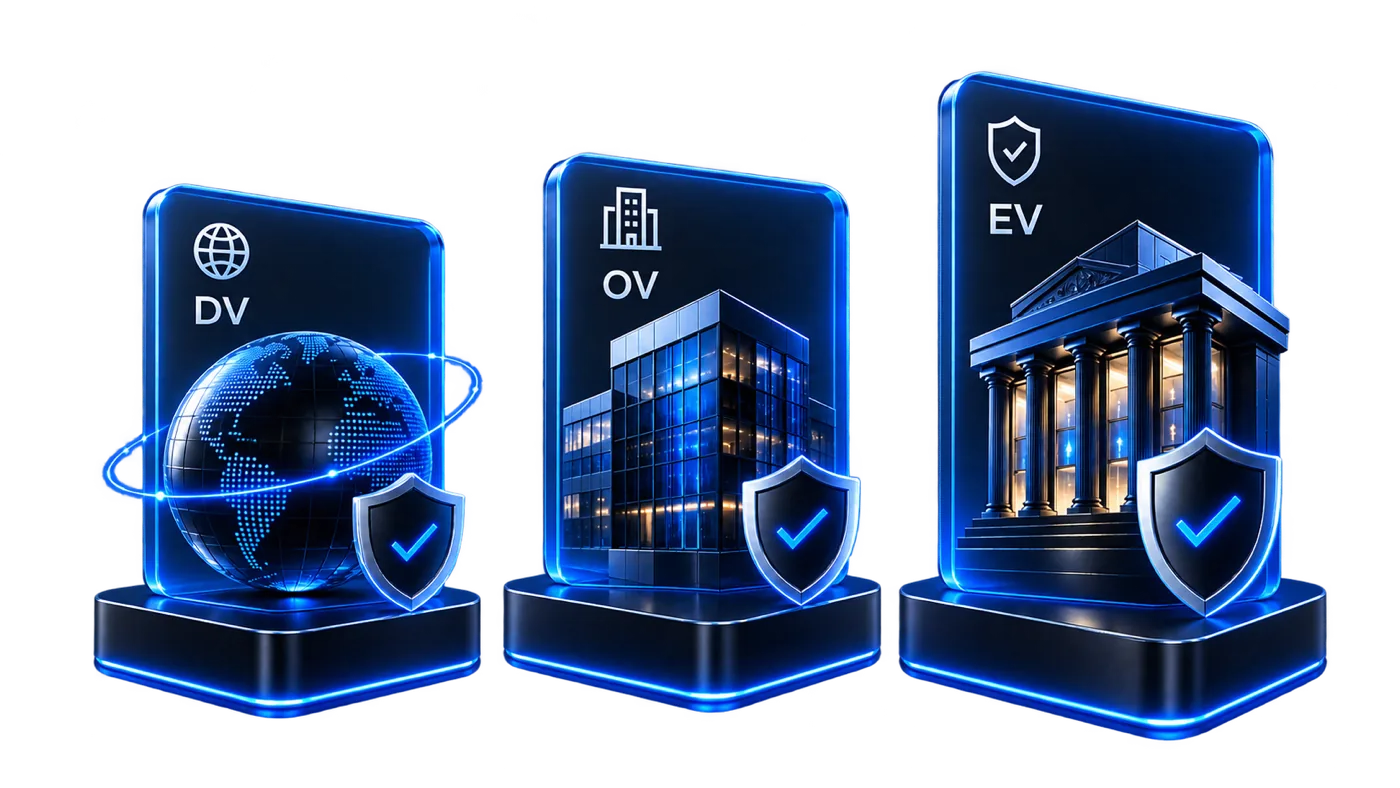
DV — domain validation | OV — organization validation | EV — extended validation | |
|---|---|---|---|
| What is verified | Domain ownership | Domain and organization details | Company via extended procedure |
| Assurance level | Low | Medium | High |
| Best for | Websites, blogs, landing pages | Companies and online stores | Finance and enterprise |
| Issuance time | Within minutes | 1–3 business days | 1–7 business days |
Four steps to HTTPS
Match the type to the task: compare DV, OV and EV in the catalog — or ask us and we will help you decide.
Pay for the certificate in the billing panel — the order is created automatically and the details arrive by email.
For DV, confirming the domain via DNS or a file is enough. For OV and EV the certificate authority reviews company documents.
We install the certificate on your server, set up the HTTPS redirect and verify everything works.

Guarantees and trust
Certificates are issued by the accredited authority SSL.com — terms are fixed, with no fine print.
- 99%+ browser compatibility
- Certificate authority warranty
- Secure payment
- Free installation help
Warranty coverage depends on the certificate type and is defined by the certificate authority

SSL questions, answered
Short and to the point: certificate types, CA warranty and installation. Can't find your answer? Write to us in chat.
An SSL certificate encrypts the connection between the website and its visitors and confirms the domain is genuine. Browsers flag sites without HTTPS as not secure — that scares visitors away and hurts search rankings. With a certificate, passwords, forms and payments are protected from interception.
The depth of vetting. DV only confirms domain ownership and is issued within minutes. OV additionally verifies the organization — company details appear in the certificate. EV is the strictest verification of a legal entity: the highest level of trust for finance and enterprise.
A Wildcard protects a domain and all its first-level subdomains: example.com, shop.example.com, mail.example.com — with a single certificate. That is simpler and cheaper than issuing a separate certificate per subdomain, and new subdomains are covered without reissuing.
Multi-Domain, also known as a SAN certificate, protects several different domains with one certificate — for example, example.com, example.net and example.org. The domain list is set at issuance and can be extended later. It suits companies with several websites or domain zones.
It is the financial liability of the certificate authority. If a certificate is compromised due to a CA error and the website's users suffer losses, the warranty covers the damages. The amount depends on the certificate type and is stated in the SSL.com terms.
Free and turnkey: once the certificate is issued, hand server access to the {{COMPANY_NAME}} team — we install it, set up the HTTPS redirect and verify everything works. Prefer to install it yourself? We will guide you step by step.
Question 01
Why does a website need an SSL certificate?
An SSL certificate encrypts the connection between the website and its visitors and confirms the domain is genuine. Browsers flag sites without HTTPS as not secure — that scares visitors away and hurts search rankings. With a certificate, passwords, forms and payments are protected from interception.
Why You Need an SSL Certificate
An HTTPS certificate makes the connection between a website and a browser secure. That is critical whenever personal data is being transmitted. It greatly reduces the risk of interception for the information users enter into registration, login, and payment forms.
An SSL certificate with domain validation is a simple way to show users that the connection to your site is secure. Small blogs and large corporate sites are no different in this respect. But for the following kinds of sites, buying and installing a certificate should be planned in advance and not put off:
online stores;
corporate websites;
services with user accounts;
sites with contact forms;
projects that process personal data.
Ever opened a web page and seen the browser message “This connection is not secure”? To keep that from happening on your site, you need to buy and install an SSL certificate. That, in turn, lowers the chance that the browser shows a warning and the visitor leaves.
How to Choose an SSL Certificate
First, you should know that there are several types of SSL certificates. We cover them below. Which one should you pick? It depends on how your project is structured. Start by working out how many domains and subdomains you need to protect.
Certificates differ by validation level (DV, OV, EV) and by the number of names they cover (single domain, Wildcard, Multi-Domain). These can be combined: for example, there are OV Wildcard and EV Multi-Domain certificates.
The main SSL certificate types:
DV (Domain Validation) — verifies control of the domain. Suitable for most standard websites, blogs, landing pages, and small commercial projects.
Wildcard — protects first-level subdomains (*.example.com); check the product page to see whether example.com itself is included.
Multi-Domain — lets you protect several different domain names with a single certificate.
A Wildcard SSL certificate is a good choice if your project has several subdomains and you want to protect them all with one certificate. A multi-domain SSL certificate is more convenient for projects that need to protect several independent domains. In that case there's no need to buy a separate certificate for each site.
Type | Best for | Key feature |
|---|---|---|
DV | Standard website, blog, landing page, brochure site | Basic domain check |
OV | Company and organization websites | Additional validation of the organization named in the certificate |
EV | Projects that need extended identification of the organization | In-depth validation of the organization the certificate is issued to |
Wildcard | Projects with subdomains | One certificate for first-level subdomains |
Multi-Domain | Several separate domains | Protects several domains at once |
Domain Validation and Installation
For many standard projects, an SSL certificate with domain validation (DV) is enough. The certificate authority checks that you control the domain you specified, and then issues the certificate.
Installation at Leneex is free: give our engineers access to your server and they will install the certificate, set up the HTTPS redirect, and check the result. You can also install it yourself, and we'll walk you through the steps. After installing the SSL certificate, check that HTTPS works and that every element on your pages loads over the secure connection. Pay particular attention to images, scripts, styles, and forms.
How to Pick a Certificate
Before you buy, ask yourself a few questions:
How many domains do you need to protect?
Does your site have subdomains?
Is proof of domain control enough?
Do you need to protect several subdomains with one certificate?
Do you need to use one certificate for several independent domains?
How is the certificate renewed?
If you have a single standard website, a regular DV certificate is enough. If you have many subdomains, consider a Wildcard certificate, and for several separate domains, a Multi-Domain one.
Buy an SSL Certificate at Leneex
We support the use of SSL certificates for websites hosted on the platform's servers. Once the certificate is connected, the domain can be used over HTTPS.
Before you buy an SSL certificate, work out your site's structure and how many domains you need to protect. That makes it much easier to pick the right option without paying for features your project doesn't need.
If you can't decide, contact Leneex support. We'll help you choose what's right for you.
The DV, OV and EV catalog — from €11 per year. Free installation.