







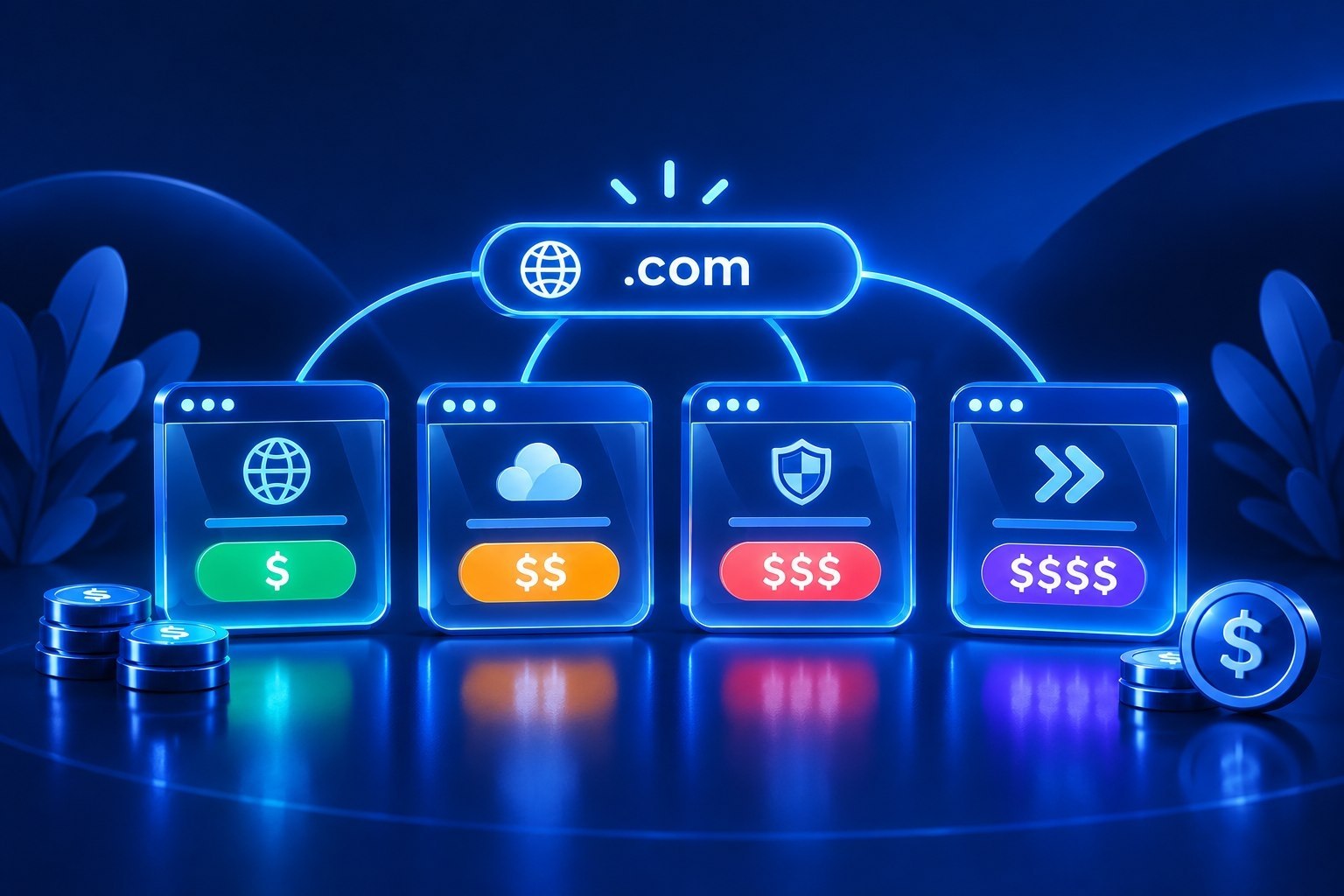
The price of a domain varies between registrars because the final figure is made up of several layers: the wholesale price set by the domain zone's registry, ICANN fees for gTLDs, the registrar's own markup, first-year promotions, and add-on services. The difference between offers can be several times over. That's why a cheap domain in year one doesn't necessarily mean a cheap domain overall. It's better to calculate the cost of ownership over several years.
What makes up the price of a domain
A registrar doesn't invent the domain name, nor does it set the entire price on its own. There are several parties in the chain.
Component | Who sets it | What it means |
Registry fee | The domain zone's registry | The wholesale cost of registering and renewing a domain in a given zone |
ICANN fees | ICANN, for applicable gTLDs | The registrar pays mandatory fees for domain transactions |
Registrar markup | The registrar | Covers its costs, infrastructure, and support, and generates profit |
The structure depends on the domain zone. .com, .io, and other zones have different registries, contractual terms, and prices. It only makes sense to compare prices within the same zone: the price of .com from two registrars is directly comparable, while comparing it to the price of .net answers a completely different question.
.com is a good example. This zone's registry is managed by Verisign. As of September 1, 2024, the wholesale price for registering, renewing, or transferring a .com domain was $10.26 per year. Verisign has already announced that starting November 1, 2026, this price is set to rise to $10.97.
This is strictly the registry-level price, not a universal retail price for the domain owner. Other costs and the registrar's markup are added on top. gTLDs are also subject to ICANN transaction fees: for the 2026 fiscal year, registrars are charged $0.20 per registration, renewal, or transfer, and for 2027 this amount remained the same.
Why renewal costs more than buying a domain
The retail price for a customer is made up of mandatory fees, the registrar's markup and costs, plus registry fees. The result: the first year costs one price, renewal costs another. Higher, but not drastically so. Sometimes, though, the gap between the purchase price and the renewal price is substantial.
A registrar may deliberately make the first year cheap to attract new customers. After that, the domain switches over to the standard renewal price. Think of it like a discount on the first month of a subscription: users are drawn in by a low entry cost, and the real economics kick in once the customer has already committed to the service and moved their domains there.
According to the aggregator domainoffer.net, .com prices in May–August 2026 showed significant variation: at some registrars the first year cost around $3–5 under special offers, at others around $9–16, while renewal after a promotion reached as high as $18–33 at a number of registrars.
Scenario | First year | Renewal |
Aggressive promo pricing | May be below standard price | Standard price |
Standard registration | Close to the usual retail price | May barely change |
Price tied to a mandatory promo condition | Low, but with extra conditions attached | Standard rate applies after the promo ends |
Registrar pricing is never set in stone. Promotions end, registrars adjust their rates, and registries raise wholesale prices. When buying a domain, check two lines at once: "Registration" and "Renewal". Do you see roughly $1 in the "Registration" line and $20 in "Renewal"? That's not a mistake — it's simply a promotional pricing model at work.
Why the same zone costs differently at different companies
Even if two registrars obtain a domain at a comparable wholesale price, the final retail price can differ substantially. Here are the key reasons behind this.
Differences in markup. For one registrar, profit comes mainly from direct domain registration and renewal. For another, the domain serves as a customer-acquisition tool, while the main focus is on hosting, VPS, SSL, or other services.
Promotions. Registrars often price domain zones below the usual rate as part of a special promotion. This is a way to attract new customers rather than a change in the zone's actual wholesale price.
Different regional models. Keep in mind that currency, tax conditions, service region, and local pricing policy also affect the price.
Add-on services. In one plan, certain features are already included in the price; in another, you'll have to pay for them separately.
Different business models. Some registrars make money on large volumes of low-cost domains. Others set a higher price and focus on support and additional services.
And here's the key point: a low price on its own says nothing about a registrar's quality or reliability. A high price isn't a guarantee of better service either. Price is just one part of the offer.
What to look at besides price when choosing a registrar
If you choose a domain based only on the number next to the "Register" button, you risk picking a less-than-ideal option. There are five important things to check before deciding to buy a domain.
Renewal price
The most important factor. Planning to keep the domain for several years? The first-year price becomes a small part of your overall costs. A domain priced at $2 with renewal at $25 ends up costing more than one priced at $11 that stays at $11 on renewal.
Total cost over 2–3 years
Calculate: registration + renewal + mandatory add-on services. This gives you the real Total Cost of Ownership (TCO) — and that's the figure worth comparing across registrars.
WHOIS privacy
WHOIS privacy hides certain personal details of the domain owner from the public registry, where the rules of a given zone allow for this. With one registrar, the feature is included in the plan; with another, it's an add-on service. Availability and rules vary depending on the domain zone.
DNS management
Check what DNS capabilities the registrar offers. Do you need custom AAAA, CNAME, MX, TXT records? Are there any limitations? Is advanced management a paid feature? For a basic website this is a minor detail. But once you add email, a CDN, third-party services, or domain verification, DNS suddenly becomes one of the most important settings.
Transfers and support
Find out the cost and conditions for transferring a domain to another registrar. A domain doesn't have to stay forever with the registrar where it was first registered. If the price jumps sharply after a year, it may be cheaper to transfer the domain than to renew it. Also evaluate the quality of support. Once a domain is tied to a website and corporate email, a registration or DNS issue quickly becomes a real business problem.
Conclusion
The price of a domain isn't a single number. Break down each registrar's domain pricing into its components, and you'll easily see where the truth lies. There's the registry's fee, mandatory charges, the registrar's own costs and markup, and on top of that, promotional discounts and add-on services can be layered in.
You need to read the price list a bit more carefully. Don't just ask "how much does it cost to register a domain?" Ask "how much will it cost to own it over the next three years?" That's a completely different question, and it's much easier to answer once you have three figures in front of you: the registration price, the renewal price, and the cost of any add-on services you actually need. You can check current figures for your domain zone on Leneex's domain registration page — just as you would with any other registrar.