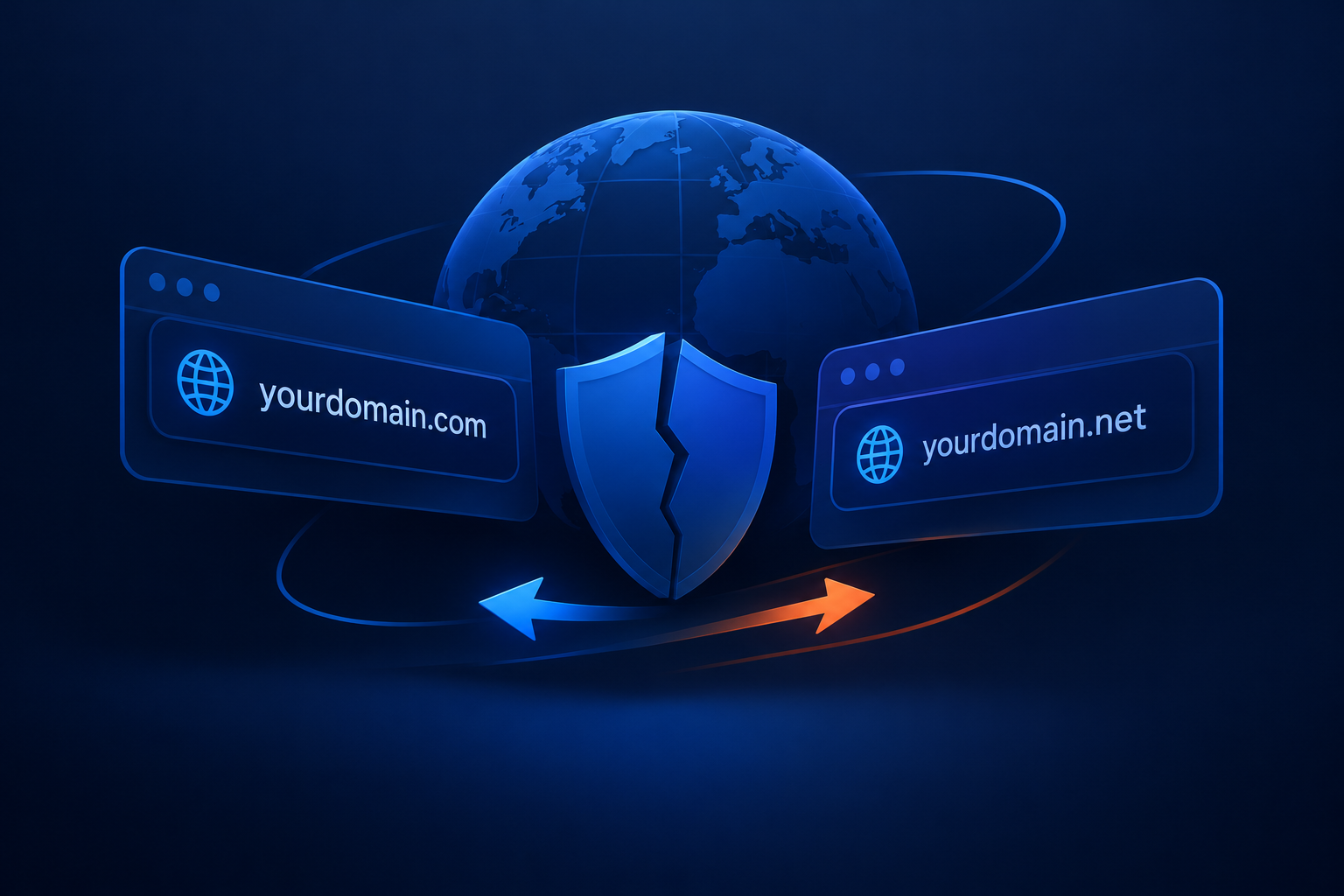







Preparing to choose a domain requires some groundwork. A well-chosen domain on its own won't automatically turn your site into a leader in its niche, but one thing is certain – it will save you from a lot of headaches down the road. Pick the wrong name, and promoting the site or building your own brand becomes an uphill battle. That's hardly what anyone wants. At the same time, a well-chosen domain can meaningfully boost a site's visibility in search engines and bring in more organic traffic.
Does the domain directly affect search rankings
A domain sends certain signals to search engines, but its influence can't be compared to content quality, page relevance, backlinks, the site's technical health, and other major ranking factors. It's important to separate direct and indirect factors here. A good domain is solid groundwork for a future project. But a domain alone won't get you to the #1 spot on Google.
As the saying goes, everything needs to be in order – the domain, the content, and the technical setup. A great domain name? Sure, that's a plus. But what good is it if the site has no content, or the content is low quality, the site loads slowly, or isn't optimized? Still, coming back specifically to the domain name, there's one simple truth worth highlighting.
The foundation of foundations – a concise domain name
Take a short, clear address like leneex.com
It's immediately obvious that users will find it far easier to remember, say out loud, or type from memory than a long, confusing name. A short, concise company name supports promotion and boosts brand recognition. If only because, over time, users start recognizing the brand in search results and are more likely to click through to a site they already know.

In that case, the domain earns an extra point in the SEO column from search engines – thanks to easy recognizability. That's exactly how its edge over competitors starts to show: through recognition, convenience, and how the site is perceived.
The impact of keywords
The situation with keywords is similar. Google states directly that keywords in a domain name or URL carry only a minor ranking impact on their own. Google even has a dedicated system called Exact Match Domain. It emerged as a tool to keep sites from gaining excessive weight purely because their domain matches a search query word-for-word. An address like best-places-to-eat-lunch shouldn't automatically get an advantage just because it contains the entire query.
Historically, Google announced a specific algorithm update targeting EMDs back in September 2012. So today, choosing a domain purely on the principle of "the more keywords in the address, the better" is an outdated strategy.
How to choose a TLD (domain zone) for SEO
A domain zone is the ending of the address: .com, .ru, .de, .org, .net. From an SEO standpoint, there's no rule that says one zone is always better than another. The choice depends on the project's geography and purpose.
Zone | Use case | SEO impact |
.com | International projects, brands, commercial sites | A universal zone that doesn't provide any special advantage on its own |
.net | Tech and network-related projects, services | Neutral in terms of geography |
.org | Organizations, communities, nonprofit projects | No tie to a particular country |
National ccTLD | Sites targeting a specific country | A signal of national focus |
New gTLD | Niche and commercial projects | Generic zones with no SEO signal of their own |
Google is believed to recognize the geographic audience of sites on national domains. If a site runs on a .de domain, that's a signal to Google that the resource has a German target audience. This is why, for a business operating in Germany, a national domain (ccTLD) like .de makes more sense than .com.
If it's an international project, though, and you're planning to expand into several countries down the line, a universal zone is the smarter long-term choice for steady, scalable growth. As for Yandex, regionality is also a kind of signal for that search engine. Yandex factors in a site's region when ranking results for geo-dependent queries, and the region can be set and confirmed through Yandex Webmaster tools and organization data.
There's one subtlety worth mentioning, though: the domain zone isn't the only way to confirm a region. For international projects, proper URL structure, page language, hreflang, contact information, and other signals matter just as much.
If you're choosing a server for a site whose audience will mostly be from Germany or France, paying attention to infrastructure is a smart move. And this is where a webmaster can genuinely improve their site's rankings – by hosting it on a VPS in Frankfurt, Amsterdam, or any other data center geographically close to the target audience. By picking the right VPS from Leneex, you can significantly cut down network latency for your regional audience.
Domain length and structure
When choosing a domain name, the main thing is to think carefully about how easy it is to read, remember, and type correctly.
Signs of a good domain:
short or moderate length;
easy to pronounce;
easy to write down without clarification;
no complicated transliteration;
doesn't look like a random string of characters;
doesn't create ambiguity;
matches the brand name or the project's theme.
Google doesn't treat a long domain as automatically bad. That's not the case. It comes down to user signals – a long, complicated domain name is simply much harder to remember and type than a short, clear one. If you choose a long domain name, you risk hurting your SEO indirectly, but there's no penalty or sanction purely for character count.
What's best to avoid
Don't use too many hyphens. One hyphen in a domain name is fine, especially when you need to separate words that would otherwise blur together and become hard to read. What you definitely shouldn't do is use constructions like "best-vps-vds-servers". That's a clear case of overload. A hyphen itself isn't an SEO problem – Google recommends using hyphens to separate words in a URL and advises against underscores as a substitute.
Also, don't overload the name with numbers. That's acceptable when the numbers are part of the brand and feel natural. A simple example is "flowers24" – it's immediately clear this is an online flower shop that's open around the clock. But add a few more digits to that name, and the whole effect disappears.
Avoid complicated transliteration. Don't turn a Russian-language brand into a long, awkward string of letters – instead, think of a simple, internationally friendly version. Search engines take a dim view of resources that use misspelled variations of well-known brands. A domain like that immediately loses credibility.
Keywords in a domain: is an exact-match domain (EMD) worth it
An EMD is a domain that matches the target query as closely as possible. The approach to SEO used to be rather different. But over time, SEO best practices shift – what worked back then doesn't work today. You can still find plenty of sites online where the domain name itself includes the most relevant possible keyword. If a company specializes in car repair, everyone used to chase down a domain like remont-avto.
The logic was simple: if the search query sits right there in the domain, the search engine should treat the site as maximally relevant. But betting on that today doesn't make sense, if for no other reason than that the Exact Match Domain System specifically prevents exact-match domains from gaining an outsized advantage.
Pros of EMD
Users instantly understand what the project is about.
In some niches, the address is easier to remember.
The name can make sense even without any brand awareness.
The keyword itself can help explain what the site does.
Cons of EMD
The domain can look generic or spammy.
It's harder to turn into a strong brand.
As the business grows, the name can become too narrow.
Matching the query itself doesn't guarantee high rankings.
A good EMD is often already taken or has a questionable history.
Remember one simple rule: if a project is built to last for years, a brand name will be far more promising than trying to cram the main search query into the domain.
Domain and brand: is a brand name worth choosing
For a long-term project, a brand domain is far more versatile. Here's a common scenario: a hosting company starts out selling VPS. A domain name like cheap-vps seems to describe the service perfectly. But two years later, dedicated servers, domain registration, CDN, and other products show up in the lineup. Now you're stuck with a situation where the company name boxes the company in.
To avoid that, before registering a name, think carefully about what products you might add down the road as the company scales. It's better to choose a neutral name that promotes the company as a brand and doesn't limit the range of services or products it can offer.
There's another important factor too – recognizability. A user might see a brand in an ad, an article, on social media, or hear about it from a friend, and then search for the company name specifically. Google recommends choosing a unique, clear site name that truly represents its identity, rather than just using the most generic possible set of keywords.
Buying a domain with history (a drop domain) for SEO
A drop domain is a domain that previously belonged to someone else, was then released, and became available again for registration or purchase. Such addresses are sometimes considered for their past: a domain may have accumulated backlinks, mentions, age, and a track record. But buying a domain just because it's "old" or has a lot of links is often a bad idea or a risky one.
The key problem is that an entirely different project may have occupied that address in the past. For example, you might want to build a hosting site today, while that same domain previously hosted an online clothing store. In that case, most of the old backlinks will have nothing to do with the new topic.
To avoid running into trouble with promotion, before buying make sure to check:
what used to be on the domain;
whether its topic changed over time;
which sites linked to it;
how natural the backlink profile looks;
whether there's a large number of suspicious or irrelevant links;
whether the domain was ever used for doorway pages, spam, or other shady schemes.
To check its history, look through web archives and public domain data, and review the backlink profile using available link analysis tools.
Main risks of drop domains
Spam history. In practice, it happens that a domain was previously used to mass-publish low-quality pages.
Irrelevant links. Another unpleasant situation is when the links were built around a completely different topic.
Questionable anchor text. The backlink profile may show signs of artificial link building.
Reputation issues. Perhaps the most dangerous scenario is when a domain was used for malicious or unwanted content.
A good new domain with no questionable past beats a cheap "aged" address with impressive-looking metrics.
Checklist: how to vet a domain before registering
Before you pay, go through a few simple steps.
Check name availability. Make sure the domain you want is actually free in your chosen zone. If it's taken, don't just grab the closest-looking alternative – especially if the existing site operates in the same niche.
Check the name as a brand. Search for the same or a similar name on Google, Yandex, social media, and among companies in your industry.
Check trademarks. If the name matches a well-known brand or looks like a variation of one, it's best to stop and do additional legal due diligence.
Consider how it sounds when spoken. Dictate the domain to another person. Did they immediately understand how to spell it? If so, you're good.
Check the domain zone. For an international project, .com or another generic zone is usually the optimal choice. For a site with a clear national focus, consider the matching ccTLD.
Check the history if the domain isn't new. Look at what site used to be at that address, whether the topic changed, and which sites link to it.
Check its reputation. Before buying a previously-owned domain, make sure it isn't tied to spam, malware, or other problems.
Think about the project's future. Don't choose a name that will become too narrow the moment the business expands.
Plan the infrastructure right away. Once registered, the domain should be connected to hosting or a VPS. If the provider lets you manage both the domain and the server from a single panel, that simplifies the initial setup of the project.
With Leneex, you can consider registering a domain and then connecting it to a suitable VPS infrastructure, provided the relevant services and locations are available in the catalog.
Conclusion
The right domain for SEO isn't necessarily one with a keyword baked into the name. First and foremost, aim for an address that's easy to remember, pronounce, and associate with your project. Then factor in your business's geography, a matching domain zone, the address's history, and legal cleanliness.
For an international project, versatility and branding matter more. For a local business, a national domain zone can serve as an extra signal of the target country. And an EMD is only worth considering when that kind of name genuinely suits the business – not in pursuit of some mythical guaranteed SEO bonus.
Once you've chosen a domain, all that's left is to properly configure DNS, HTTPS, hosting or a VPS, and the site itself. If the infrastructure is already in place, you can register the domain and immediately connect it to a server in a suitable location.