








Choosing a reliable host isn't as simple as it used to be. There are plenty of offers out there, and just as many criteria to weigh. Picking the right hosting is half the battle when it comes to building a solid infrastructure for a small business. Hosting for small business should be evaluated based on reliability, speed, security, and scalability. Of course, an intuitive control panel and responsive technical support matter too — because a business owner shouldn't need a sysadmin on standby just to fix a routine website issue.
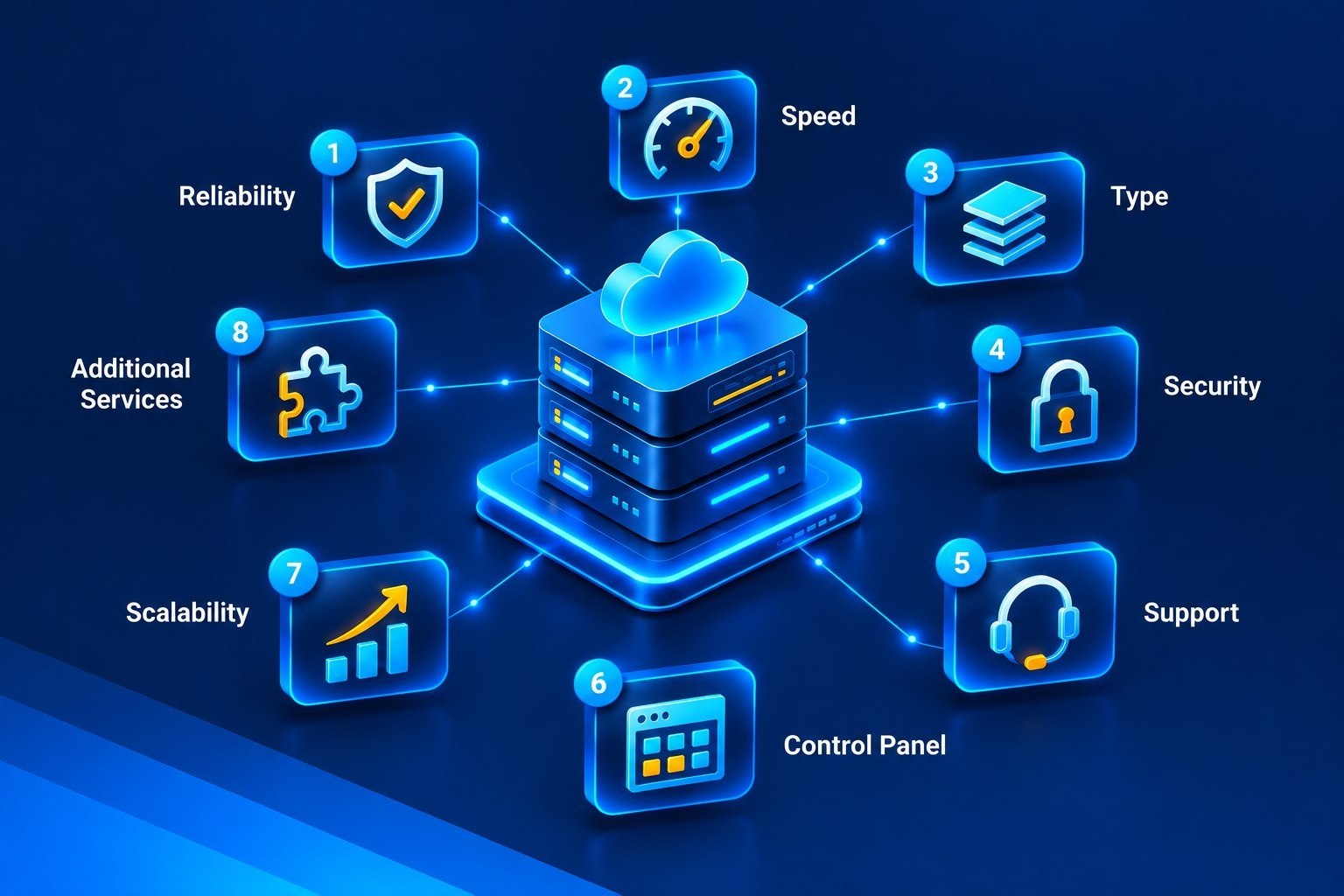
What about cost? Price matters too, but comparing plans on price alone is a poor strategy. Cheap hosting might turn out to be a bad fit once your site grows, and switching providers later takes time and risks downtime. That's why it pays to evaluate several criteria upfront.
Reliability and uptime
Uptime is the percentage of time a server and the sites hosted on it remain accessible to users. The higher the number, the less time your site is potentially unavailable due to infrastructure issues. For a business, downtime isn't just a technical hiccup. Visitors can't browse your catalog, submit a form, or find your contact details. If your site drives sales, bookings, or lead generation, stability becomes one of the key selection criteria.
When comparing providers, don't just look at the advertised uptime — check the SLA (Service Level Agreement) terms too. The agreement should spell out availability guarantees, exclusions, and compensation procedures if those terms are breached.
What to check in an SLA:
what uptime percentage is guaranteed;
what exactly counts as downtime;
which situations are excluded from the calculation;
how downtime is tracked and recorded;
whether compensation is provided if terms are violated.
It's worth checking a provider's reputation and independent uptime monitoring reports. A single polished number on a pricing page doesn't tell the whole story about a service's track record.
Loading speed and its impact on your business
Have you noticed how website speed affects the user experience? We tend to close a slow-loading site almost instantly. Some visitors will bounce before they even see what a company has to offer. For an online store, a service platform, or a site that handles a lot of inquiries, that impact is very real.
Loading speed isn't determined by hosting alone. You need to look at the bigger picture: site code, images, CMS, database, number of requests, and the performance of third-party services. Upgrading to a more powerful plan shouldn't be treated as a cure-all for every performance issue.
When choosing hosting, pay attention to data center location. The closer the server is to your main audience, the lower the latency between users and the server. If your company mainly serves clients from a specific region, it's worth considering a server location closer to that audience.
For a small project, start with a basic plan — try a free shared hosting plan — and move to a VPS as traffic grows. Consider Leneex VPS, when choosing a provider, you can check in advance whether suitable locations and scaling options are available on current plans.
It's best to evaluate speed holistically — don't just look at server specs, but also at actual site performance test results.
Type | Best for | Features |
Shared hosting | Small websites, landing pages, corporate sites | Physical server resources are shared among multiple clients; management is usually simpler |
VPS | Growing websites, online stores, projects with specific requirements | A dedicated virtual environment with more control over configuration |
Cloud | Projects with variable or high load | Resources and architecture can scale depending on the service configuration |
Hosting type: shared, VPS, cloud — what works for a small business
For a small site, you'll typically consider shared hosting, VPS, or cloud infrastructure. They differ in hosting model, level of control, and available resources. It's worth checking upfront whether a single provider offers several hosting options. Leneex offers both shared hosting and VPS, so as your project grows you don't need to switch providers — you simply move to a different hosting type within the same infrastructure. The specific choice depends on your CMS, traffic, data volume, and the site's own requirements. The most expensive hosting type isn't necessarily what a small business needs.
Security: SSL, backups, attack protection
Website security doesn't start with antivirus software — it starts with solid underlying infrastructure and the ability to restore your data after a failure.
Check these four things:
SSL certificate. Your site should run over HTTPS. SSL/TLS protects data exchanged between browser and server and helps build trust with visitors. A free certificate doesn't mean weak encryption — Let's Encrypt issues free certificates for HTTPS.
Backups. You need to know exactly how often backups run and whether they're automated. It's just as important to understand how many copies are retained and whether you can restore your site yourself. Simply having backups doesn't guarantee a smooth recovery — what matters is being able to verify that they actually work.
Infrastructure protection. Find out what baseline protections the provider has in place against network attacks. That said, securing the application itself, the CMS, and passwords remains the site owner's own responsibility.
Incident recovery. If files ever get corrupted, you need to know what the consequences will be. The clearer the recovery procedure, the less uncertainty for your business.
We run backups on a regular schedule, so you can restore your site at any time.
Technical support
Many small companies don't have an in-house sysadmin from day one. Even a simple question — say, about site availability, domain setup, or server performance — can require technical expertise. That's where hosting support steps in and becomes a top priority.
When choosing a hosting provider, don't just check whether support exists — look at the actual terms:
which contact channels are available;
what hours support is reachable;
what kinds of issues support actually handles;
how technical issues are logged;
whether there's a knowledge base or documentation;
how quickly the provider typically responds to requests.
Look specifically for reviews about technical support. Reviews about pricing or payment convenience say little about how a provider behaves during an outage. We offer round-the-clock technical support — you can reach out to us for help whenever it's convenient for you.
Control panel and ease of administration
Small businesses don't always need someone dedicated full-time to server management. A user-friendly control panel can save a lot of time on routine tasks: managing websites, domains, databases, SSL, and other settings. There are several panels on the market — cPanel, Plesk, DirectAdmin, FASTPANEL, HestiaCP — and that's just the major names; there are many more overall. Each differs in interface, feature set, and server requirements.
When choosing one, focus less on the panel's name and more on your company's specific needs. If a non-technical employee manages the site, an intuitive interface matters far more than a long list of rarely used settings. The core idea is simple: the fewer routine operations that need to be done manually through the console, the lower the learning curve for whoever is responsible for the site.
Scalability
A small business website rarely stays the same for long. A company might launch an online store, add a catalog, run an ad campaign, introduce a customer account area, or simply attract more visitors. Along with that comes increased load on CPU, RAM, disk space, and other resources.
With good hosting, you can scale up resources easily without migrating your infrastructure. In an ideal scenario, a company starts with a basic plan and then moves to a higher-performance configuration as the project grows. A VPS is typically the next step after shared hosting — it gives you more control over the virtual environment and lets you tailor the configuration to your project's specific needs.
So here's what to focus on:
whether you can change your plan;
which resources can be scaled up;
how complex the move to a more powerful configuration is;
whether the site will need to be migrated;
whether there are limits on disk space or other resources.
The ability to grow without being forced into migrating to a new provider matters far more than a small price difference between plans.
Additional services: domains, email, SSL bundled in
Having your core services in a single control panel is convenient. You manage your domain, hosting, and SSL all in one place. If an issue ever comes up, it's easier to pinpoint which service it relates to. Business email deserves separate consideration too — an address on your own domain looks more professional than a personal mailbox and is more convenient for your team. But don't choose email hosting just because a mailbox is bundled into the plan — security, mailbox management, and other factors matter just as much.
These questions are covered in detail in a separate article, "Email Hosting for Business" — it's worth reading when choosing an email solution, without mixing up email and web hosting criteria. It's convenient when a single provider handles domains, hosting, SSL, and infrastructure management — everything is easier to manage that way. But before purchasing, always double-check exactly what's included in a given plan and which services come with an extra charge.
Conclusion
Don't choose hosting for your small business based on a single factor or on price alone. The best option is one that offers stable site performance, suitable speed, a baseline level of security, and straightforward management — and that lets you scale up resources easily as your project grows. If your site is just launching, start with a basic plan and check in advance how easy it will be to move to a more powerful configuration.
If your project already needs more flexibility, more control over resources, or you're anticipating significant growth in traffic, consider renting a virtual server. If criteria like scalability, location choice, and flexible resource configuration matter to you, check out our plans and compare them against your project's requirements.