









Dedicated hosting, or a dedicated server, is the rental of an entire physical server for exclusive use. All of its processors, RAM, storage drives, and other hardware resources are reserved for a single client, rather than being shared among multiple users.
With VPS, several virtual servers run on a single physical host. And that's where the key difference lies — dedicated hosting gives you the entire machine at your disposal. It's the highest level of control over server hardware, but it also comes at a higher cost and demands more administration.
How a dedicated server works
A dedicated server is a regular server-class physical computer installed in a data center. The provider gives the client access to the machine, connects it to the network, and keeps the data center infrastructure running, while the client manages the operating system and installed software. There's no virtual separation of resources between clients: one server physically belongs to a single rental.
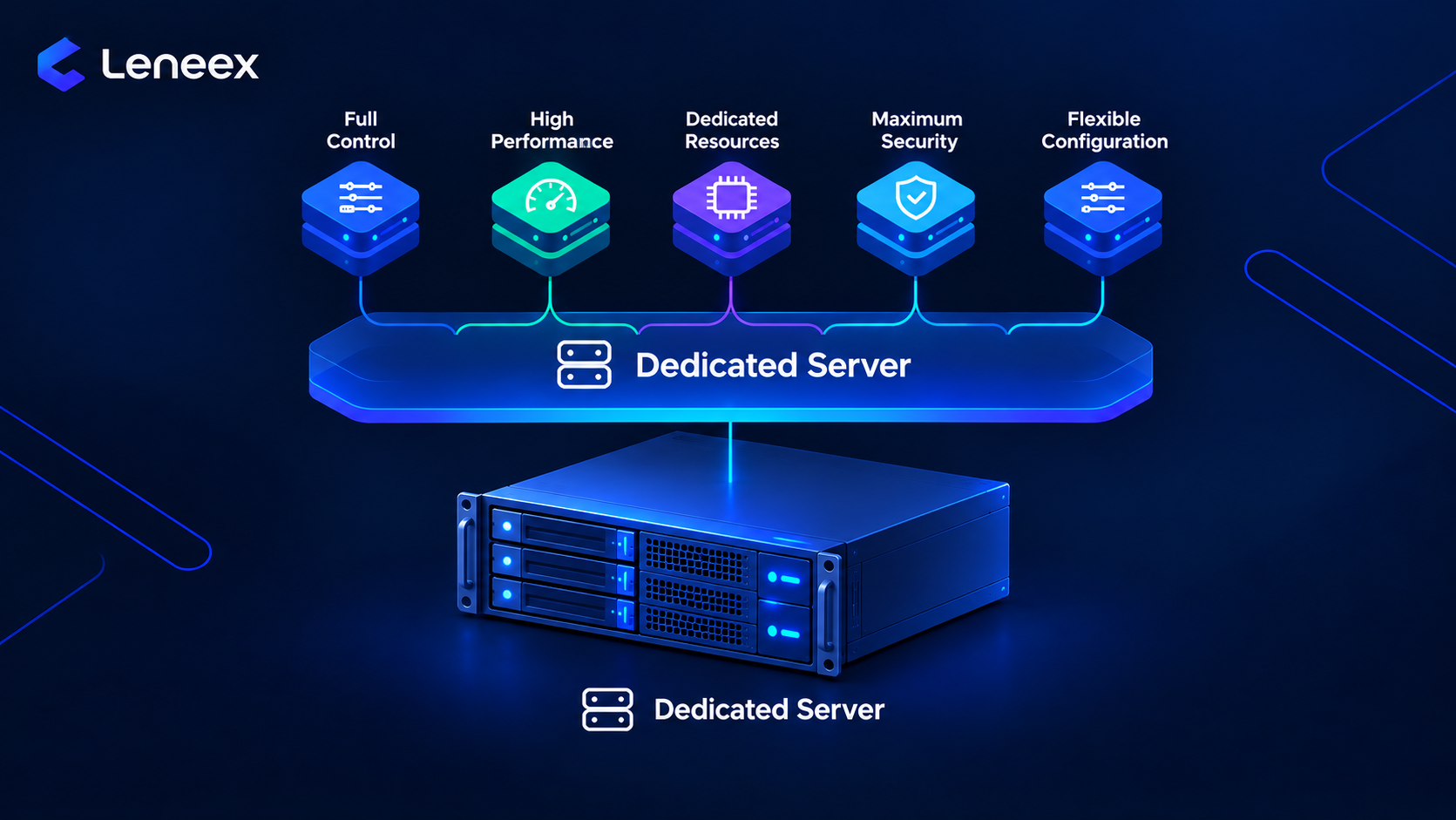
Dedicated servers have a few distinctive features:
a separate physical machine — the server doesn't share CPU and RAM with virtual machines belonging to other clients;
full control over the OS — you install and configure software yourself;
access to hardware resources — the client uses all of the server's equipment within the terms of the rental agreement;
bare metal — a term used to describe a physical server running without a virtualization layer that would otherwise split its resources among multiple tenants.
Dedicated doesn't necessarily mean the provider gives the client physical access to the hardware. The server sits in a data center, and management happens remotely.
How dedicated differs from VPS and shared hosting
You can think of these three options as three levels of control. With shared hosting, multiple websites live in a shared hosting environment. The user gets a ready-made infrastructure but has almost no control over the server. A VPS is created inside a physical server using virtualization. Each client gets their own virtual machine with root access and can install software independently.
Dedicated, on the other hand, is an entire physical machine used only by you — and no one else. With that in mind, imagine the capabilities and the sheer power you get.
Parameter | Shared hosting | VPS | Dedicated |
|---|---|---|---|
How it works | Multiple websites in a shared hosting environment | A virtual machine inside a physical server | An entire physical server for a single client |
Level of control | Minimal: the provider manages the server | Root access and your own OS | Full control over OS, software, and configuration |
Resources | Shared among all sites on the server | A dedicated share of the physical host's resources | All resources of the physical machine |
Maintenance | Barely required | Basic server administration skills needed | Requires expertise and responsibility for the entire server |
Cost | The lowest | Mid-range | The highest |
Best for | Small sites and beginners | Projects that need root access and flexibility | High-load projects with specific hardware requirements |
The key here is not to think of VPS as a "weaker version" of a dedicated server. For many tasks, a virtual server is perfectly sufficient: a site gets its own OS and server environment, and there's simply no need to pay for an entire physical machine.
If you need root access and a separate server environment but don't need the full power of physical hardware, renting a VPS is the smarter, more cost-effective choice. To learn more about how a virtual server works, check out our VPS guide.
Pros and cons of dedicated hosting
A dedicated server gives you maximum control, but you pay for it with more than just money.
Advantages
High performance
One of the strongest advantages of a dedicated server is that absolutely all of the physical machine's hardware resources go toward a single project. You won't need to share the CPU and RAM with virtual servers belonging to other clients.
Predictable resources
With the right configuration, it's far easier to plan for load: the available hardware is known in advance, and there's no competition for physical resources from neighboring virtual machines.
Full control
You choose the operating system that fits best, install server software, and configure networking, virtualization, and other components yourself.
Physical isolation
The project's infrastructure sits on a separate machine. For many companies, that's a critical requirement due to internal policies or infrastructure specifics.
Specialized configurations
Dedicated servers are a great fit when a project needs specific hardware characteristics — a large amount of RAM, a particular type of storage drive, or a custom server configuration.
Disadvantages
High cost
This is one of the main downsides of a dedicated server. The client has to pay for the entire physical machine, even if the project is only using a fraction of its resources at any given moment.
Overkill for small projects
In practice, that's usually the case — a newly launched corporate website, a small online store, or an app with moderate load simply doesn't need the kind of power a physical machine can provide.
Harder to scale
Your project might suddenly grow, and that's when the first problems appear. The lack of processing power becomes noticeable right away. With a VPS, a resource shortage is easier to fix — everything changes on the software side. With a physical server, scaling means moving to more powerful, more modern hardware.
Administration requirements
More control also means more responsibility. Updates, security, service configuration, backups, and monitoring largely fall on the administrator. Some of these tasks can be handed off to specialists if you choose a managed dedicated server — not every provider offers this service, so its availability and terms should be checked separately.
When you really need a dedicated server
A dedicated server makes sense not because it's "more powerful than VPS," but because the project needs the resources and properties of a separate physical machine.
High load. Large web services, databases, and APIs require substantial amounts of CPU and RAM. When a regular VPS isn't enough, a separate physical server becomes one of the scaling options.
Large databases. For some databases, the amount of RAM, storage performance, and resource predictability really matter.
Physical isolation requirements. Organizations often need their project's hardware to be physically untouched by other clients. If a company wants to install its own hypervisor and create its own virtual servers inside the physical machine, dedicated hosting provides a suitable foundation for that.
Custom virtualization. If a company wants to install its own hypervisor and create its own virtual servers inside the physical machine, dedicated hosting provides a suitable foundation for that.
Specialized hardware. Sometimes a project needs a particular combination of CPU, RAM, storage drives, or other hardware characteristics. Dedicated hosting lets you pick a physical machine tailored to the specific task.
When you don't need dedicated hosting
Picture a typical online store, corporate website, or web application with moderate load. If the project runs well on a VPS and its resources can be scaled up as it grows, moving to a physical server won't bring any automatic benefit.
In that case, it's smarter to use a VPS with a suitable configuration and scale it as needed. If you're not yet sure whether you actually need dedicated hosting, starting with a VPS is usually more rational than paying upfront for a physical server with extra capacity you may not use.
Bottom line
Dedicated hosting makes sense when a project needs separate physical hardware, maximum control, or a significant amount of resources. It's not an obligatory next step after shared hosting: for many projects, moving to a VPS fully covers the need for root access, a dedicated OS, and an isolated server environment.
Rather than following the logic "the more powerful the server, the better," base your choice on the project's actual load and requirements. If a separate physical machine isn't needed yet, a reasonable starting point is Leneex VPS, which lets you pick a configuration that fits your current needs and scale resources as the project grows.
FAQ
How does a dedicated server differ from VPS?
A VPS is a virtual server running inside a physical host alongside other virtual machines. Dedicated is a separate physical server given entirely to one client.
How much does a dedicated server cost compared to VPS?
Dedicated servers cost more than VPS since the client rents an entire physical machine. The final price depends on the CPU, amount of RAM, storage drives, location, and additional services offered by the provider.
Do you need technical skills to administer a dedicated server?
Yes, if the server isn't managed. Users may need knowledge of Linux or Windows Server, networking, security, backups, and configuring server applications.
Can you move from VPS to dedicated later?
Yes. That's a normal scaling path: a project starts out on a VPS and, as requirements grow, gets moved to a physical server. Before making the switch, check configuration compatibility and plan the migration of data and services.
What is a bare metal server — is it the same as dedicated?
In a hosting context, the terms are often used to describe a physical server provided to a single client. "Bare metal" emphasizes the absence of a virtualization layer between the operating system and the physical hardware, so the term can be used slightly more broadly.