






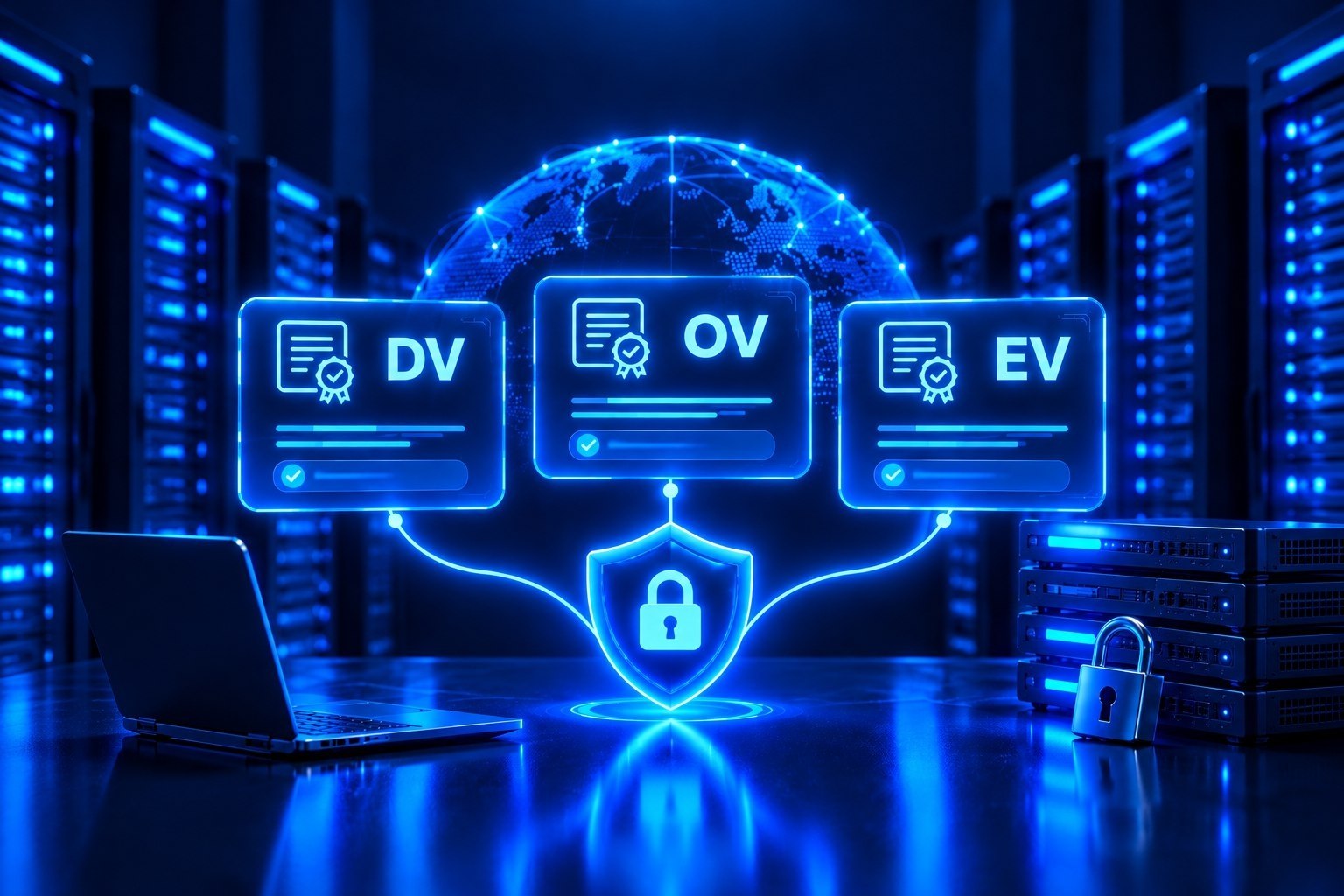
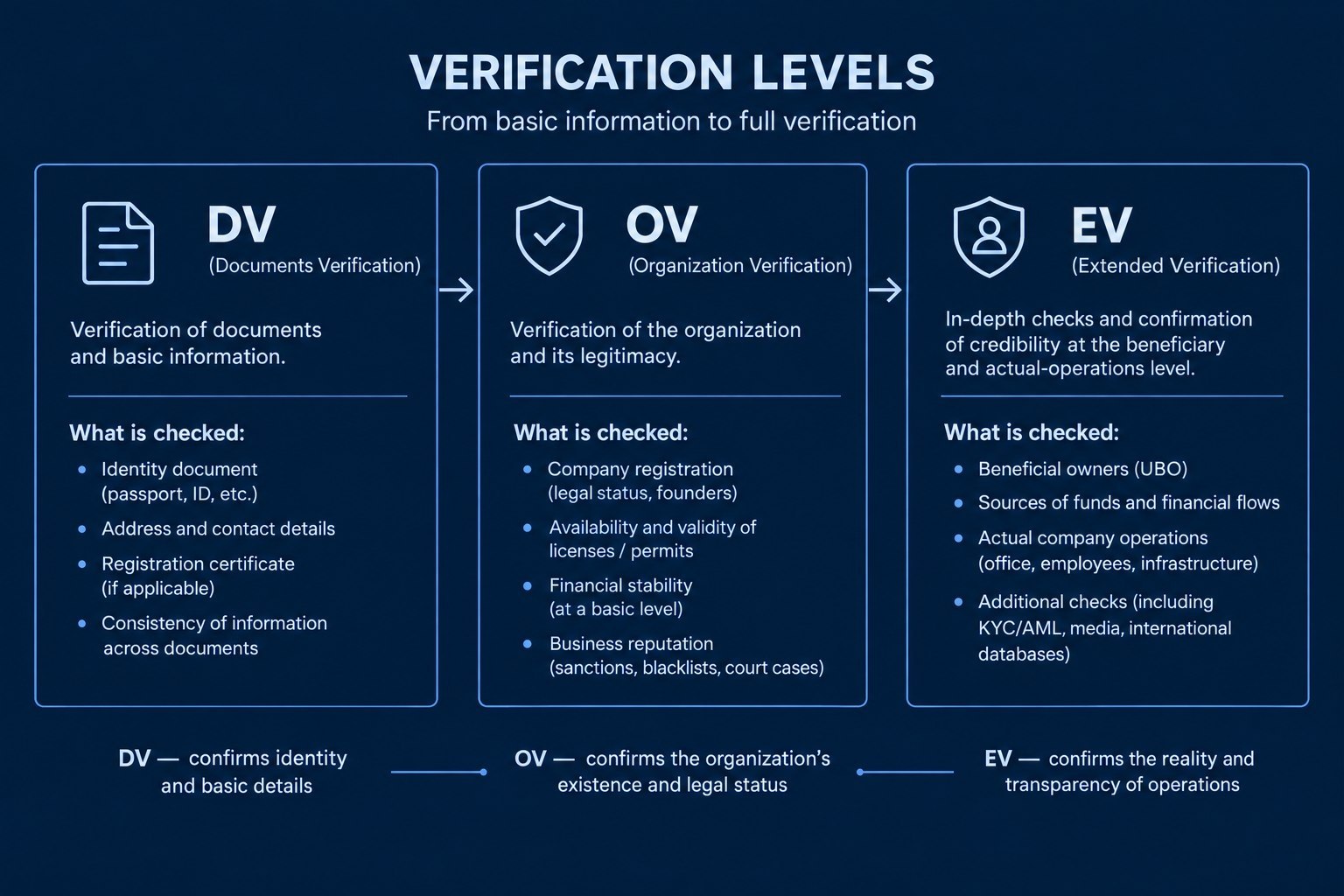
DV, OV, and EV SSL certificates differ in how deeply they verify the identity of the website owner. DV confirms control over the domain, OV additionally verifies the organization, while EV involves the most thorough verification of the owner's legal, physical, and operational existence.
All three types are used for the same TLS connection: the level of validation doesn't mean that EV "encrypts more strongly" than DV. The question of "which SSL certificate to choose" isn't really about the technical security of the connection — it's about how much identity verification your business actually needs.
DV (Domain Validation) — the basic level
DV, or Domain Validation, is the simplest verification level. The certificate authority confirms that the applicant controls the specified domain. Verification happens through DNS, by placing a specific file on the site, or through other approved methods of confirming domain control. The CA isn't required to establish whether a specific legal entity stands behind the domain. Once control over the domain is confirmed, the DV certificate can be issued.
The main advantage of DV is the simplicity and automation of issuance. This type is widely used for regular websites, blogs, landing pages, small online projects, and APIs. A good example is Let's Encrypt — a free certificate authority that issues only DV certificates and doesn't offer OV or EV.
For most sites, this is more than enough. Users get HTTPS, and the connection between browser and server is protected with TLS. In a VPS environment, automation makes this convenient: in FASTPANEL, HestiaCP, DirectAdmin, and Plesk, Let's Encrypt certificates are issued and renewed automatically, without having to go through the process manually each time. In cPanel, free DV certificates are handled by AutoSSL.
If free Let's Encrypt isn't enough and you need a commercial DV certificate, you can order one on the Leneex DV SSL certificates page.
OV (Organization Validation) — organization verification
OV, or Organization Validation, adds organization verification on top of domain verification. The CA must confirm that the specified organization actually exists and matches the data that will appear in the certificate. This is a different level of identification compared to DV: the certificate is tied not just to domain control, but to a verified organization.
OV makes sense for companies that need to confirm their legal identity. This matters for both small and large companies that actively handle business correspondence, corporate services, or B2B interactions. There's an important nuance here: a site visitor won't necessarily see a prominent "OV" visual indicator in the browser. Modern browsers no longer use the HTTPS interface as a simple indicator of certificate type.
You shouldn't buy this type of certificate purely expecting a noticeable label about a verified company to appear next to the site's address. Its value lies in the fact that the organization and the data included in the certificate have been more thoroughly verified. OV issuance typically takes longer than automated DV, since additional verification is required. The exact timeframe depends on the specific certificate authority and how quickly the necessary information can be confirmed.
You can order a certificate with organization verification on the Leneex OV SSL certificates page: prepare your company data in advance, as the certificate authority will request it.
EV (Extended Validation) — extended verification
EV, or Extended Validation, involves the strictest organization verification among the classic DV/OV/EV levels. Current CA/Browser Forum requirements call for verifying not just the existence and identity of the organization, but also its physical presence, operational activity, domain control, and other details.
Specifically, the current EV Guidelines require confirming the legal existence and identity of the organization, as well as its physical presence and operational activity. In other words, EV answers a more complex question: "Who exactly is behind this site, and is it really an existing organization?"
EV can be used where identifying the site owner carries particular significance: in the financial sector, large e-commerce projects, corporate services, and other systems where trust in the legal entity is a key part of the interaction. But EV doesn't turn a site into a "more encrypted" version of HTTPS. The TLS connection doesn't automatically become stronger just because the certificate has EV status.
If your project genuinely needs extended verification, you can order an EV certificate on the Leneex EV SSL certificates page. Issuance time depends on the certificate authority and the completeness of the data provided.
What about the green address bar?
Outdated materials on the topic of SSL often claim that an EV certificate shows a green address bar with the company's name. For modern browsers, this description is outdated. Back in 2019, Mozilla moved EV information from the address bar to the site information panel, explaining that users don't perceive the difference between certificate types well enough.
In the desktop version of Firefox 70 (released October 22, 2019), the EV information was removed from the address bar, and Mozilla specifically noted that it has no plans to bring such an indicator back. Buying EV today just for the "green bar" doesn't make sense. Its value lies in the deeper verification of the site owner's legal identity, not in a special browser interface color.
DV vs OV vs EV — comparison table
Parameter | DV | OV | EV |
|---|---|---|---|
What's verified | Domain control | Domain + existence and data of the organization | Domain + organization, legal, physical, and operational existence |
Depth of verification | Basic | Medium | Maximum |
Issuance time | From a few minutes to a few hours | Usually 1–3 business days | Longer than OV; depends on the CA and completeness of the data |
Price | Free (Let's Encrypt) or low-cost paid options | Paid, typically more expensive than DV | Paid, typically the most expensive |
Organization data in the certificate | No | Yes | Yes, extended verification |
TLS encryption | No difference | No difference | No difference |
Best suited for | Blogs, portfolios, landing pages, APIs, small projects | Company websites, B2B services | Financial sector, large commercial platforms |
The key takeaway from the table: DV, OV, and EV are levels of validation, not three different levels of encryption.
How to choose the right type of SSL certificate
Base your choice on what the site actually needs, not on how many letters are in the certificate's name.
Personal blog, portfolio, or landing page — DV
If the goal is simply to enable HTTPS, secure the connection, and confirm domain control, a DV certificate is already more than enough. For most small sites, there's no practical reason to complicate things and pay for extended organization identification. Free DV from Let's Encrypt is convenient wherever automatic issuance and renewal matter.
Company website — DV or OV
For a typical corporate website, the first thing to determine is whether the company actually needs verified identity in the certificate. If HTTPS is mainly needed to secure the connection and keep the site functioning correctly, DV is a good choice.
If, on the other hand, it matters to the company to use the certificate as an additional way to confirm its legal identity, OV is worth considering first. Don't expect automatic gains in user trust just because of the letters "OV" in the certificate. Many users don't even know which certificate type is installed on a site. You might install an OV certificate, but users simply won't notice.
Online store — usually DV, sometimes OV or EV
Simply running an online store doesn't make EV mandatory. For an online store, what matters far more is properly functioning HTTPS, application security, account protection, payment infrastructure, cookies, and personal data. EV is worth considering if the business needs extra verification of its legal identity and the corresponding level of identification. But that's a business decision, not a technical requirement of running an online store.
Financial and large commercial projects — EV
It makes more sense to consider EV where the organization's identity is a meaningful part of trust in the service. This could include financial companies, large marketplaces, and other organizations for which passing extended verification and having the corresponding data in the certificate matters.
However, the decision should be made not on the basis of "EV is more secure," but based on business requirements and the expected value of extended validation.
Does the type of SSL certificate affect SEO
There's no reason to choose EV in order to improve your site's search rankings. Whether a certificate is DV, OV, or EV isn't a way to get an extra SEO boost. HTTPS overall matters for security and for the modern web, but moving from DV to OV or EV doesn't make a site more relevant to search engines.
Conclusion
The difference between DV, OV, and EV lies in how deeply the certificate owner is verified. DV confirms control over the domain. OV adds organization verification. EV goes further and includes extended verification of the owner's legal, physical, and operational existence. Neither OV nor EV automatically means "stronger encryption." All three types are TLS certificates, and the validation level is a separate characteristic related to identifying the owner.
If DV is enough for an ordinary website, then a company that needs verified organizational identity should go with OV. EV, meanwhile, is ideal if the business needs extended verification — not just for show, but to confirm real business value.
The easiest way to get a free DV certificate is on a VPS with FASTPANEL, HestiaCP, DirectAdmin, or Plesk: Let's Encrypt is issued and renewed automatically. If you need organization verification, order a Leneex OV SSL certificate. If you need extended verification of legal identity, choose a Leneex EV SSL certificate. Judge it by your business's actual requirements, not by the impressive-sounding name.
FAQ
What's the main difference between EV and OV certificates?
Both types involve organization verification, but EV applies a stricter set of requirements for confirming the organization's legal, physical, and operational existence. The current EV Guidelines formalize these requirements separately.
Does an EV certificate show a green address bar in the browser?
No, you shouldn't count on a green address bar. Modern browsers have dropped the old, prominent EV indicator in the address bar; for example, desktop Firefox removed it back in version 70 (2019).
Can you get an OV or EV certificate for free?
Free automated Let's Encrypt certificates are DV only: the organization explicitly states that it doesn't issue OV or EV. OV and EV are typically obtained from commercial certificate authorities, so terms and pricing need to be checked with the specific CA or vendor.
How long does it take to issue an EV certificate?
There's no fixed timeframe. It depends on the CA, how complete the submitted data is, and how quickly the organization's details can be confirmed; EV requires substantially more verification than automated DV.
Is EV required for an online store?
No. An online store doesn't need EV just because it accepts orders or payments. In most cases, a properly configured TLS certificate is enough, and whether EV is needed depends on additional business requirements.